
INSTRUCTION MANUAL
Protection against cold at or below −5 °C
Use, cleaning, care and maintenance of your garment.
Garments and certificates
3 garments use this manual. The CA number is on the label.
- Validity stated in the PDF
- 01/05/2030
Layer by layer
Multicamadas
Protects the user's torso and upper limbs against thermal agents (cold), for ambient temperatures below -5 °C.
Protection limits. PPE NOT RESISTANT TO WATER PENETRATION.
Description and source of the data
Cold-protection torso garment for temperatures at or below -5°, made of three layers: Canvas 300 – 100% polyester, 1x resin; a synthetic polyester fibre batting, 150 g/m²; and an inner bember layer, 100% polyester, 70 g/m². Sizes: XS, S, M, L, XL, XXL and TE or 40-42, 44-46, 48-50, 52-54, 56 58, 60-62, 64-66 and 68-70
Transcript of this CA’s instruction manual · reviewed on October 1, 2026. The printed validity does not replace checking the current status at CAEPI.
The manual is the primary source for this edition. The certificate below keeps the original content, including any documentary differences.
See the full source ↗INSTRUCTION MANUAL FOR TORSO PROTECTIVE GARMENTS, PANTS AND BALACLAVA FOR PROTECTION AGAINST THERMAL AGENTS (COLD)
Reference: balaclava cap for protection against thermal agents (cold) - Temperatures at or below -5 °C – CSW - 11
CA: 52.289
Reference: torso protective garment against thermal agents (cold) - Temperatures at or below -5 °C – CSW - 12
CA: 52.260
Reference: pants for protection against thermal agents (cold) - Temperatures at or below -5 °C – CSW - 13
CA: 52.261
01Manufactured and sold by
+
Commanders Industrie e Comércio de confecções Ltda
Avenida Governador Roberto da Silveira, 751 – Vila São Carlos – Apucarana – PR – Postal code 86800-520
CNPJ Head office 01.699.525/0001-20
CNPJ Branch 01.699.525/0003-91
CNPJ Branch 01.699.525/0004-72
CNPJ Branch 01.699.525/0002-00
02Product designation (full description)
+
Reference: protective garment, balaclava type – CSW - 11
CA: 52.289
Hood for protection against cold at or below -5°, made in three layers: an outer layer of fleece, 67% polyester and 33% cotton, 270 g/m²; a middle layer of 120 g/m² synthetic polyester fiber batting; and a 70 g/m² 100% polyester Bemberg inner layer, with an eye opening.
Sizes: one size or S, M, L
Reference: torso protective garment – CSW - 12
CA: 52.260
Torso protective garment against cold at or below -5° made in three layers: Lona 300 – 100% polyester canvas with 1x resin coating, 150 g/m² synthetic polyester fiber batting, and a 70 g/m² 100% polyester Bemberg inner layer.
Sizes: XS, S, M, L, XL, XXL and XXXL, or 40-42, 44-46, 48-50, 52-54, 56 58, 60-62, 64-66 and 68-70
Reference: protective garment, pants type – CSW - 13
CA: 52.261
Pants for protection against cold at or below -5° made in three layers: Lona 300 – 100% polyester canvas with 1x resin coating, 150 g/m² synthetic polyester fiber batting, and a 70 g/m² 100% polyester Bemberg inner layer.
Sizes: XS, S, M, L, XL, XXL and XXXL, or 40-42, 44-46, 48-50, 52-54, 56 58, 60-62, 64-66 and 68-70
03ASTM test standard number
+
EN 342 for protection against thermal agents (cold) - Temperatures at or below -5 °C
04Pictograms
+
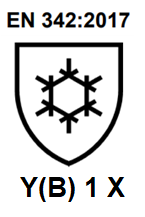
Pictogram description. Where:
Y (B) / Y (C) / Y (R) – Resulting effective thermal insulation (Icler) in m².K/W (of the ensemble (with the manufacturer's underwear B or base layer C) or of the single garment (with normal clothing R).
Y - Air permeability class (1 to 3)
WP - Water penetration
Y and/or WP will be replaced by X if the garment has not been tested and/or does not apply to the intended purpose.
05Sizing information
+
Safety garments must always be worn as a set of pants, torso protective garment and protective cap that have been tested, that provide the protection the job's risk requires for cold protection, and that have the protection level the user wants for the risk they will be exposed to.
The right size can be found by measuring the chest circumference and matching it to the ideal size on the label.
06Information for the user on environmental conditions and that workplace risks must be
+
considered.
Environmental conditions and workplace risks must be taken into account.
This PPE garment is not intended to protect against:
Cutting, piercing, scraping or abrasive agents, or chemical agents.
The user must make sure that:
• Sleeve and pant-leg closures are always fastened for a perfect fit and proper protection.
07Information for the user that deviations from the standard's parameters may result in more severe conditions
+
Not applicable
08Information for the user that the garment must always be worn fully closed
+
For correct protection, the garments must be worn covering the whole body. The upper placket closures (buttons, zipper or touch fasteners) and the upper-limb cuffs (buttons or touch fasteners) must be fully fastened.
In combinations of pants and a torso protective garment, the torso garment must overlap outside the pants, covering the waist to keep the cold out.
09User information
+
This garment has been tested to demonstrate its protection against cold.
However, note that there are 2 cold levels:
- Temperatures at or below -5 °C
- Temperatures above -5 °C
Choose the right garment for the risk involved
10Information for the user that the garment must be cleaned when needed
+
The garment's functionality may be impaired or reduced if it is dirty. Ideally, wash protective garments frequently. We suggest washing after each use.
Washing does not reduce protection, and there is no limit to the number of times the garment can be washed.
11Information for the user on appropriate use.
+
For correct protection, the garments must be used together, covering the whole body. The upper placket closures (buttons, zipper or touch fasteners) and the upper-limb cuffs (buttons or touch fasteners) must be fully fastened.
In combinations of pants and a torso protective garment, the torso garment must overlap the pants on the outside.
12Care instructions according to ISO 3758
+
Follow the washing instructions on the garment label. Below is an index of the symbols:
ISO 3758 – Guidance for home washing
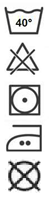
Do not use chlorine-based bleach or whiteners
A tumble dryer may be used at the lowest temperature
The fabric may be ironed at a maximum of 150 °C (ironing the tapes is not allowed
tape)
Do not dry clean
13Information for the user that the garment must be stored in a dry, clean place and not
+
must be exposed to intense light
Service life depends on how the products are used, cared for and stored, etc.
• Garments must be transported and stored at normal room temperature (ideally in a ventilated, clean and dry place).
• Even in storage, observe the PPE expiry date, which is 5 years after the manufacturing date.
14Cleaning and repair instructions
+
• Follow the washing instructions on the protective garment's label.
• Do not use bleach, whitening agents of any kind or starch, and do not treat the garment with strongly oxidizing agents.
• Wash white fabrics separately from colored ones; do not handle them with other materials that may cause significant staining.
• No detergent or auxiliary cleaning product may remain in the garment after rinsing.
• Exposure to extreme heat may cause temporary, partial changes in fabric colors.
15How to put it on
+
Torso protective garment: to use it, take it out of the packaging, open the front and the cuffs, put it on over the certified flame-retardant garment starting with the sleeves, then fasten the front placket and the cuffs securely. The excess of the torso garment at the waist must be worn over the pants.
Pants: to use them, take them out of the packaging; if there is a fly opening, open it and then put them on over the certified flame-retardant garment, starting with the legs. Close the fly or adjust the drawstring, depending on the type of closure.
Balaclava: pull it over the head, adjusting the face openings and the neck cover
16Check before putting it on
+
Note that the thermal resistance of a cold-protection garment depends on parameters such as the exposure time and the user's activity. A user who is moving generates more internal heat and can wear a garment with lower protection than a worker who stands still or sits.
The tables below give recommendations for the garments' thermal insulation according to outside temperature, exposure time, air speed and the user's activity level (metabolic heat production).
Table 5 – Recommended thermal insulation according to various parameters for EN 342:2017
Applicable standard |
Thermal insulation m².K/W |
Activity / Time of use | |||||
|
Very light (75 W/m²) User standing still |
Light (115 W/m²) Light movement |
Light (170 W/m²) Light movement | |||||
|
Icler |
Air speed: 0.4 m/s |
Air speed: 0.4 m/s |
Air speed: 0.4 m/s | ||||
|
8 h |
1 h |
8 h |
1 h |
8 h |
1 h | ||
|
EN 342 |
0,386 |
5 |
-12 |
-9 |
-28 |
-28 |
-48 |
|
Applicable standard |
Icler |
Air speed: 3 m/s |
Air speed: 3 m/s |
Air speed: 3 m/s | |||
|
8 h |
1 h |
8 h |
1 h |
8 h |
1 h | ||
|
EN 342 |
0,386 |
13 |
-3 |
0 |
-16 |
-16 |
-32 |
NOTE 1: An adequate level of whole-body insulation may not be enough to prevent cooling of sensitive body parts (for example hands, feet, face) and the risk of cold injury.
NOTE 2: How well a clothing ensemble maintains heat balance at normal body temperature depends on internal body heat production. Therefore, the protection level of a clothing ensemble is assessed by comparing the measured insulation value with the calculated required insulation value.
NOTE 3: Thermal insulation requirements for the human body in a specific cold environment are assessed based on EN ISO 11079.
17Check before putting it on
+
Before putting it on, inspect the garment to make sure it has no tears, holes or any other visible damage. If it does, the garment must be replaced immediately. Do not use it in these conditions.
18General information
+
- These garments have no chemical products or allergy-causing substances applied.
- When worn in the appropriate size for your body, the garments do not cause significant ergonomic difficulty in movement, vision or hearing. If the garment is not comfortable, check whether a size better suited to your body can be used.
- This garment is not waterproof and must not be used in operations involving water.